

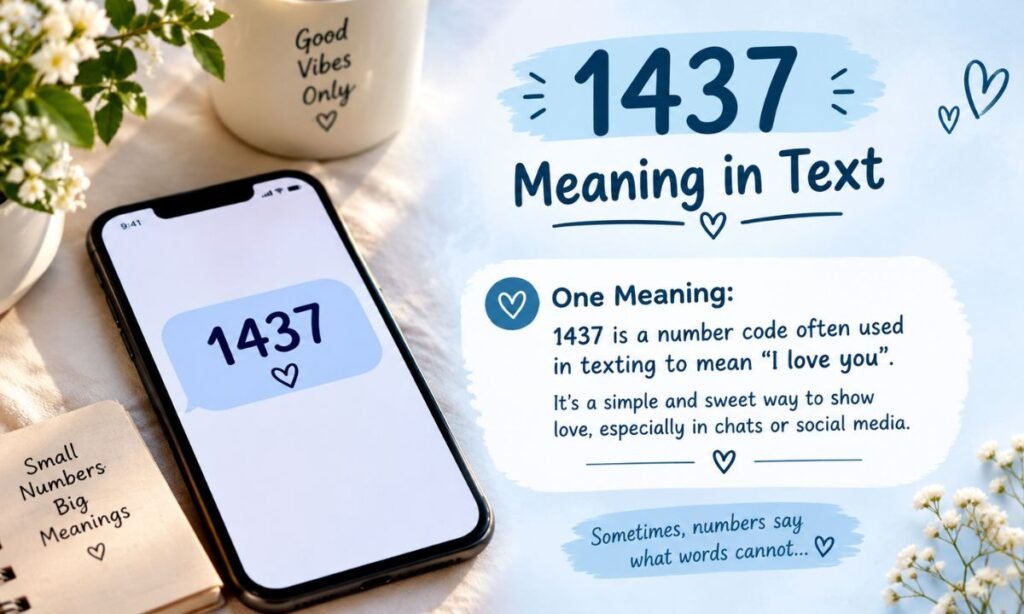
If someone just texted you “1437” and you’re sitting there confused, you’re not alone. This four-digit number shows up everywhere in DMs, TikTok comments, and end-of-conversation texts and it almost always carries one specific feeling behind it.
Understanding 1437 meaning in text will help you decode what a girl or boy is really trying to tell you the next time it lands in your inbox.In this guide, we’ll break down the full 1437 meaning, where it came from, how people use it in real conversations, and how you should reply when you get one yourself.
By the end, you’ll be able to spot the 1437 meaning instantly, understand the intent behind it, and respond in a way that matches the tone it was sent in whether that’s playful, romantic, or purely friendly.
Why 1437 Is More Than a Random Number
At first glance, 1437 looks like a random string of digits, maybe a PIN, a locker combination, or a typo. But in texting culture, numbers rarely appear by accident. The 1437 meaning is rooted in a simple letter-counting trick that turns a full sentence into a quick, private-feeling code.
That’s exactly why it caught on. It’s fast to type, it feels a little secretive, and it lets someone express real emotion without spelling everything out. For a generation that grew up texting in shorthand, 1437 fits perfectly into everyday conversation.
There’s also a psychological pull to number codes like this. A plain “I love you” can feel heavy or exposed, especially early in a relationship. A coded number softens that vulnerability while still getting the message across clearly.
That emotional cushioning is a huge part of the 1437 meaning, and it’s one reason the code keeps spreading instead of fading out like other internet trends.
1437 Meaning in Text – Quick Meaning
Here’s the short version before we go deeper:
1437 means “I love you forever.”
That’s the core 1437 meaning across nearly every platform texting, Instagram, Snapchat, and TikTok. People send it to partners, close friends, and family members as a compact way to say something heartfelt.
What Does Each Number Represent?
Each digit in 1437 stands for the number of letters in a word from the phrase “I love you forever.”
| Number | Word | Letter Count |
| 1 | I | 1 letter |
| 4 | Love | 4 letters |
| 3 | You | 3 letters |
| 7 | Forever | 7 letters |
So when you line the numbers up, 1437 literally spells out I-Love-You-Forever using letter counts instead of words. It’s a simple formula, but once you know it, you’ll never look at that number the same way again.
This letter-counting trick is the exact foundation of the 1437 meaning, and it’s also why so many similar codes exist.
Once you understand the pattern, you can decode almost any numeric love message you come across online, since most of them follow the same basic logic of matching digits to word length.
Origin & Background of 1437
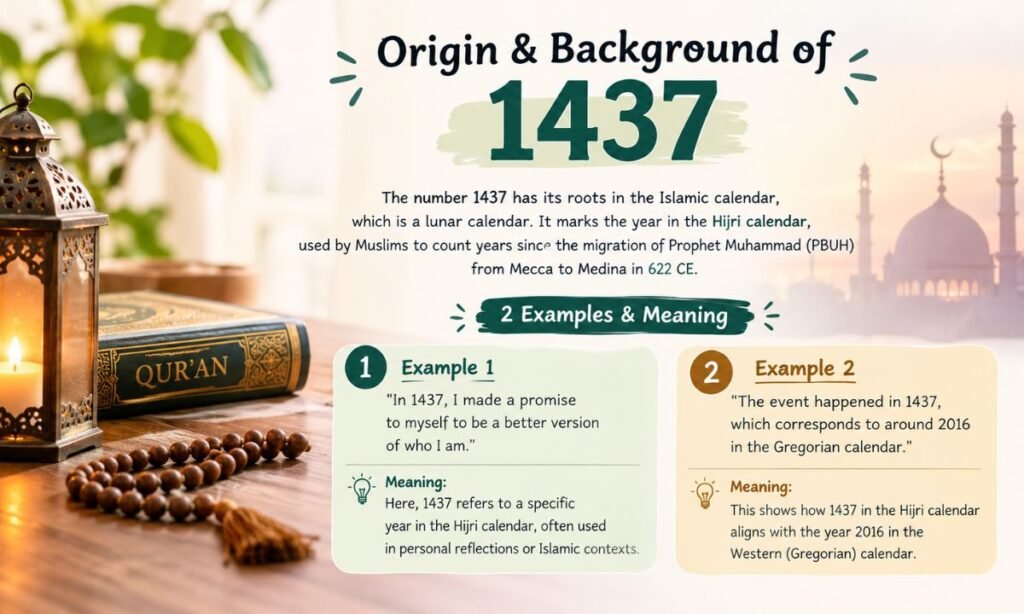
To fully understand the 1437 meaning, it helps to know where it came from. This code didn’t appear out of nowhere; it evolved from an older, simpler number that’s been around for decades.
From 143 to 1437
Long before smartphones, people used pagers and early mobile phones with strict character limits. That’s where 143 was born — a numeric code for “I love you,” based on the same letter-counting method (I = 1, love = 4, you = 3).
143 became iconic, showing up on jewelry, in songs, and even in Mister Rogers’ Neighborhood, where Fred Rogers reportedly used it as a personal signature for “I love you.” Over time, people wanted a version that expressed something deeper than a simple declaration, something that promised permanence.
Adding “7” for “forever” gave the phrase extra emotional weight, turning a casual message into a lasting commitment.
1437 Meaning Islam
There’s no religious meaning tied to 1437 in Islamic contexts when used in texting, it’s purely a secular internet code. However, in the Islamic (Hijri) calendar, 1437 AH refers to a specific year (roughly 2015–2016 in the Gregorian calendar), which is unrelated to the texting slang.
Social Media Gave the Code a New Life
While 143 quietly existed for years, 1437 exploded thanks to social media. TikTok trends, relationship videos, and viral captions introduced the number to a much younger audience. Hashtags built around the number have racked up tens of millions of views, and it’s now common to see it as a comment, a caption sign-off, or a quiet reply to a sweet message.
This is a good example of how internet culture takes an old idea and reshapes it into something that feels fresh again which is a big part of why the 1437 meaning still resonates today. What used to be a pager-era trick for saving keystrokes is now a full-blown relationship trend, complete with its own hashtags, memes, and comment-section rituals.
It’s also worth noting that the rise of short-form video played a huge role here. Because TikTok captions and comments favor brevity, a compact phrase like 1437 fit the format perfectly, helping the 1437 meaning spread faster than a written-out sentence ever could.
Real-Life Conversations Using 1437
Numbers on a page only tell half the story. Here’s how 1437 actually shows up in day-to-day messaging.
WhatsApp Between Long-Distance Partners
“Goodnight babe, miss you already. 1437 😴💕”
Long-distance couples often use 1437 as a nightly ritual, a quick way to end the day on an affectionate note without writing out a long paragraph.
Instagram DMs Between Close Friends
“Thank you for always showing up for me. 1437, seriously.”
Between friends, 1437 usually signals deep platonic appreciation rather than romantic love. It’s a way to say “you matter to me” without sounding overly formal.
TikTok Comments on a Relationship Video
“This is literally me and my boyfriend 🥹 1437”
On TikTok, the number often shows up as a comment when viewers relate emotionally to a couple’s video, tagging their own partner underneath.
Text Messages After an Argument
“I’m still upset, but I never stopped loving you. 1437.”
Interestingly, 1437 also appears after disagreements, a small olive branch that reassures the other person the relationship still matters, even during conflict.
Family Group Chats
“Made it home safe. Love you guys, 1437.”
It’s not just romantic partners and friends, many families use the 1437 meaning as a quick sign-off in group chats, especially after phone calls, visits, or long trips. It keeps the tone warm without turning into a long, emotional paragraph.
Emotional & Psychological Meaning
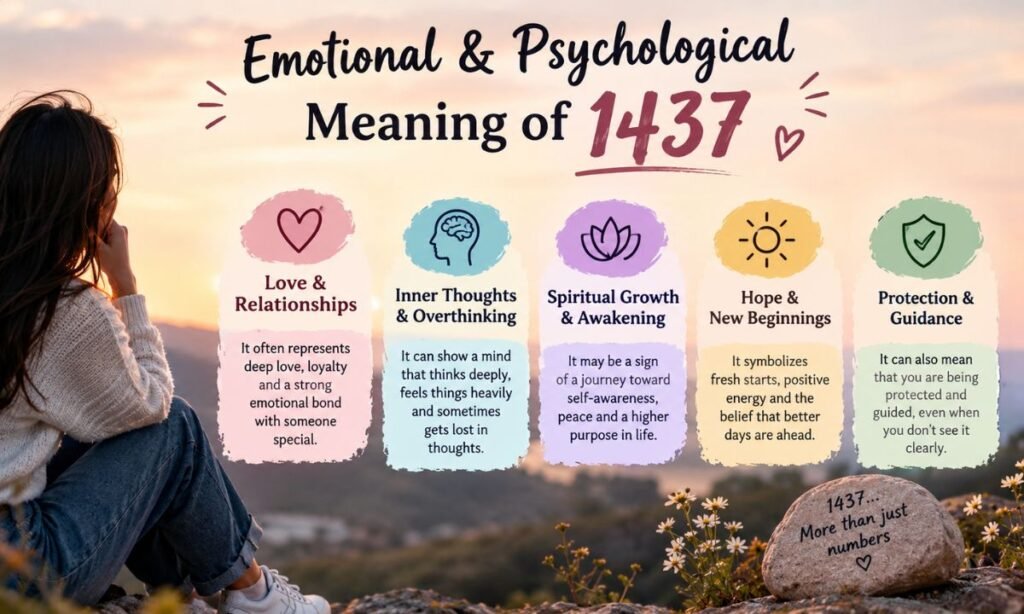
Beyond the letter-counting trick, there’s a real emotional layer behind the 1437 meaning. Psychologists who study digital communication note that short affectionate codes like this act as “micro-expressions of intimacy.” They allow people to:
- Express vulnerability without over-explaining
- Reassure a partner quickly, especially during busy days
- Maintain emotional connection in long-distance relationships
- Soften the tone of a conversation after tension
In short, sending 1437 is a small act, but it often carries a genuine emotional intention behind it especially when it comes from someone who doesn’t usually text overly sentimental messages.
It’s also worth recognizing that the 1437 meaning can act as a low-stakes way to test emotional waters. Someone who isn’t ready to say “I love you” out loud might send 1437 instead, using the code as a gentler first step toward a bigger conversation later on.
Usage in Different Contexts
The 1437 meaning stays consistent, but the context around it changes how it’s interpreted. Here’s a breakdown of where and how it’s typically used.
Social Media
On platforms like TikTok, Instagram, and Snapchat, 1437 often appears in captions, comment sections, and story replies. It’s casual, public-facing, and usually tied to relationship or friendship content.
Friends and Relationships
Between friends, it signals loyalty and appreciation. Between romantic partners, it’s a stronger declaration of long-term affection closer to “I’m in this with you” than a passing compliment.
Work and Professional Settings
This one’s simple: 1437 does not belong in professional communication. Sending it to a coworker or client, even as a joke, can come across as inappropriate or confusing.
Save it for personal conversations only, since the 1437 meaning carries emotional weight that doesn’t translate well into a workplace setting.
1437 Meaning in Chat
In everyday chat apps, 1437 usually works as a sign-off, the digital equivalent of ending a call with “love you, bye.” It’s quick, low-pressure, and easy to drop into an ongoing conversation.
Understanding the 1437 meaning in chat helps you avoid misreading a casual goodbye as something more dramatic than it actually is.
1437 Meaning in Text From a Girl or Boy — Funny
Not every use of 1437 is deeply serious. Plenty of people send it jokingly, especially in group chats or between friends who tease each other. A girl might text 1437 sarcastically after her friend does something silly, or a guy might send it as a lighthearted reply just to be funny rather than romantic.
Casual Versus Serious Tone
| Tone | Example | Likely Meaning |
| Casual/Joking | “You owe me $5. 1437 tho 😂” | Playful, not romantic |
| Serious | “Whatever happens, 1437.” | Genuine emotional message |
| Flirty | “Goodnight 🌙 1437” | Early-stage romantic interest |
| Committed | “5 years today. 1437 always.” | Long-term relationship affirmation |
Context including emojis, punctuation, and the relationship history usually makes the tone obvious. When in doubt, look at how the person typically texts: someone who never uses emotional language probably means it sincerely if they suddenly send 1437, while a friend who jokes constantly is likely keeping the 1437 meaning light and funny.
When Not to Use 1437 and Common Misunderstandings
While 1437 is generally harmless, timing and audience matter.
Situations Where It May Be Inappropriate
- Sending it to a new coworker or boss
- Using it with someone you’ve just met, which can feel too intense too soon
- Sending it publicly when the relationship isn’t clearly defined yet
- Using it as a joke with someone who might take it seriously
What People Often Get Wrong
Some common misconceptions about the 1437 meaning include:
- Thinking it’s a secret code with hidden or negative meaning it isn’t.
- Assuming it’s only used romantically, when it’s often platonic too.
- Believing it originated on TikTok, when it’s actually rooted in the older 143 code.
- Overanalyzing a joking or casual 1437 as a serious declaration.
- Assuming the 1437 meaning changes depending on who sends it, when in reality the core phrase stays the same only the intent behind it shifts.
1437 Compared With Similar Texting Codes
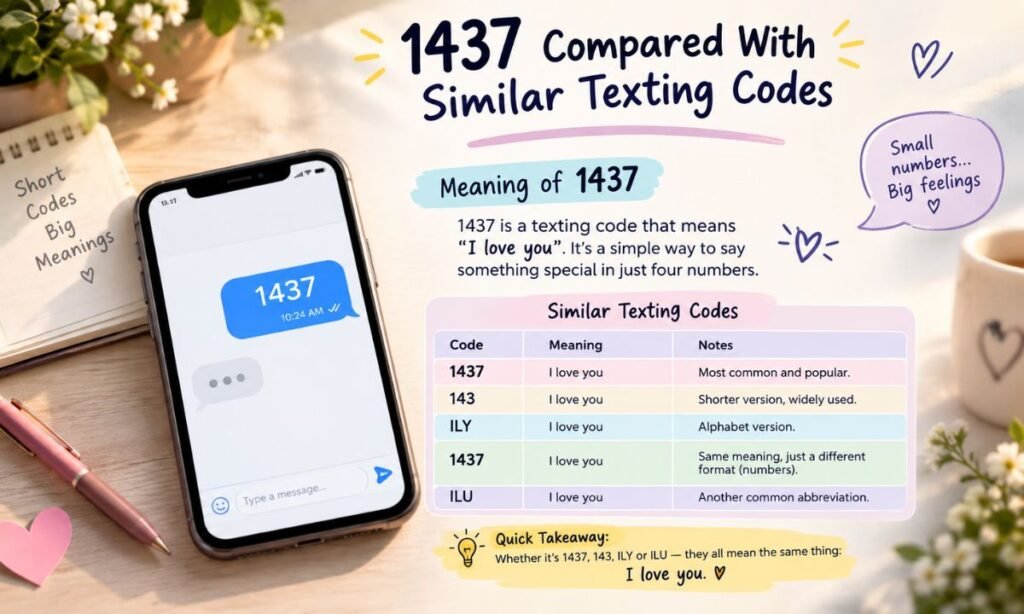
There’s a whole family of numeric love codes, and knowing them helps put the 1437 meaning into perspective.
| Code | Meaning | Breakdown |
| 143 | I love you | I(1) Love(4) You(3) |
| 1437 | I love you forever | I(1) Love(4) You(3) Forever(7) |
| 14344 | I love you very much | I(1) Love(4) You(3) Very(4) Much(4) |
| 14372 | I love you too | I(1) Love(4) You(3) Too(2) |
| 143637 | I love you always and forever | Extended variant of 1437 |
| 831 | I love you | 8 letters, 3 words, 1 meaning |
| 520 | I love you (Chinese) | Based on pronunciation, not letters |
14344 Meaning
14344 adds “very much” to the phrase, making it “I love you very much” — a slightly stronger version of plain 143, but without the permanence implied by 1437.
14372 Meaning
14372 translates to “I love you too,” commonly sent as a direct reply when someone says “I love you” first.
143 Meaning
143 is the original code for “I love you,” and the direct ancestor of every extended version, including 1437.
1437 Meaning in Love
Within romantic relationships specifically, 1437 signals long-term commitment. It’s less about a passing feeling and more about reassuring a way of saying “this isn’t going anywhere.”
1437 Which Country
1437 isn’t tied to any single country. It originated in English-speaking texting culture and spread globally through social media, though similar number-based love codes exist in other languages, such as 520 in Chinese.
1437 Meaning in Text Urban Dictionary
On crowdsourced slang sites like Urban Dictionary, 1437 is consistently defined the same way: “I love you forever,” reinforcing that this isn’t regional slang but a widely recognized digital shorthand.
1437 Reply
If someone sends you 1437 and you feel the same way, replying with 1437 back is the simplest and most natural response.
Key Insight
The single most important thing to remember about the 1437 meaning is this: it’s a compact way of saying “I love you forever,” and its emotional weight depends entirely on the relationship and context it’s sent in. Don’t overthink the number itself, focus on who sent it, how they normally text, and what’s happening in the conversation around it.
Variations and Related Types of 1437
Beyond the codes already mentioned, you may also come across:
- 1437 with emojis (❤️🖤💕) — softens or personalizes the message
- 1437 in bios — used as a subtle relationship marker
- 1437 anniversary posts — marking relationship milestones
- 1437 tattoos — some couples ink the number as a permanent symbol
- 1437 jewelry — engraved bracelets, necklaces, and rings using the number as a subtle love token
- 1437 playlists or song titles — creators naming content around the code to attract viewers who already know the 1437 meaning
How to Respond When Someone Sends 1437
Not sure how to reply? Here are a few directions depending on your relationship and how you feel.
Casual Replies
- “1437 too 💛”
- “Aw, love you”
- “Same here!”
Funny Replies
- “1437… and you owe me tacos”
- “Noted. 1437 back at ya 😂”
Mature Replies
- “That means a lot. I feel the same way.”
- “I love you too, always.”
Respectful Replies When You Do Not Feel the Same
- “That’s really sweet of you to say, thank you.”
- “I care about you a lot, even if I’m not there yet.”
Honesty, even when it’s gentle, is always better than leading someone on with a code you don’t mean. Since the 1437 meaning is emotionally loaded, replying thoughtfully even briefly shows the other person you actually understood what they were trying to say.
Regional, Cultural, and Generational Usage
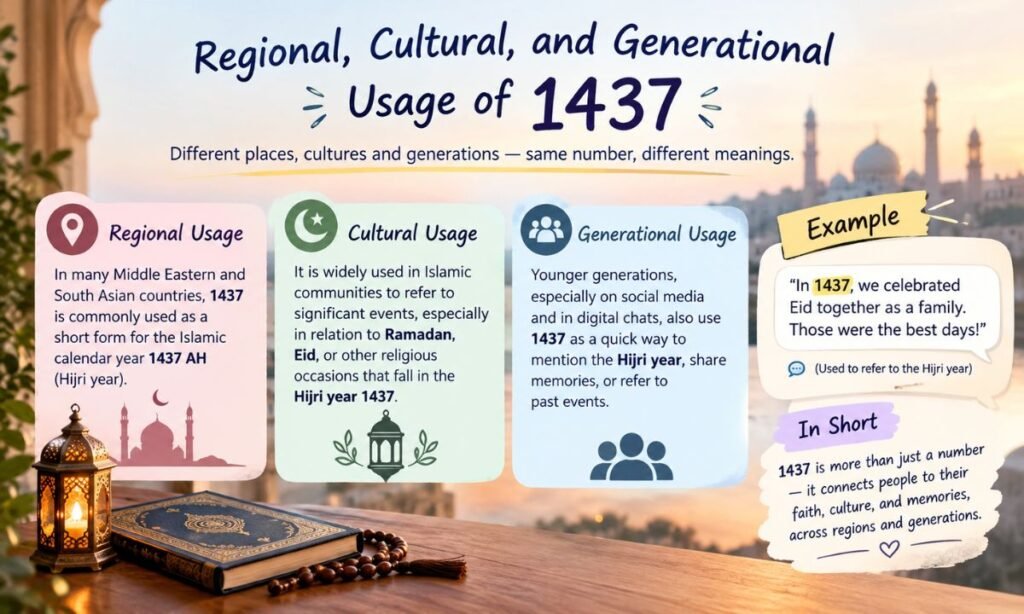
The 1437 meaning stays fairly consistent worldwide, but usage habits shift by region and generation.
Western Culture
In the US, UK, and Canada, 1437 is widely recognized, especially among teens and young adults active on TikTok and Instagram.
Asian Culture
In parts of Asia, numeric love codes exist in local forms too like 520 in China though 1437 has also spread through English-language social media exposure.
Middle Eastern Culture
Usage is growing among younger, social-media-active users, though it remains more common in English-language conversations than in fully localized slang.
Global Internet Usage
Because platforms like TikTok operate globally, the 1437 meaning has traveled far beyond its English origins, appearing in bilingual captions and comment sections worldwide.
It’s now common to see it mixed into captions written in Spanish, Arabic, or Tagalog, with the number itself staying untranslated while the surrounding text switches languages.
Gen Z Versus Millennials
| Group | Usage Style |
| Gen Z | Frequent, casual, often in comments and captions |
| Millennials | Less frequent, more sentimental, often private texts |
Is 1437 Safe for Kids?
Yes, 1437 is not explicit, harmful, or inappropriate content. It’s simply an affectionate shorthand comparable to saying “I love you” to a parent, sibling, or friend.
Parents generally don’t need to worry if they see this number in a child’s messages, though it’s always worth understanding the context of who it’s being sent to.
Unlike other coded slang that can hide risky behavior, the 1437 meaning is openly documented across dozens of teen-slang glossaries and social platforms, which makes it easy for parents to look up and verify. If a child is using it with friends or family, it’s almost always harmless.
The only time it’s worth a gentle conversation is if it’s being exchanged with someone significantly older or someone the child hasn’t met in person, since that context matters more than the code itself.
Frequently Asked Questions
What does 1437 mean in texting?
1437 means “I love you forever,” based on the number of letters in each word of that phrase.
Is 1437 always romantic?
No. While it’s common in romantic relationships, it’s also used between close friends and family members platonically.
Who started 1437?
It evolved from the older code 143 (“I love you”), gaining widespread popularity through TikTok and other social platforms.
Should I reply if someone sends me 1437?
Yes, a short reply is polite even a simple “aw, thank you” acknowledges the message respectfully.
Is 1437 the same in every country?
The core meaning stays the same globally, though some regions use different numeric codes, like 520 in China.
Can 1437 be used platonically?
Absolutely. Many people use it with best friends or family members to express appreciation, not just romance.
Conclusion
At its core, the 1437 meaning comes down to four simple words hidden inside four digits: “I love you forever.” What started as a small evolution of the classic 143 code has grown into one of the most recognizable numeric expressions of affection on the internet today.
Understanding the 1437 meaning also gives you a small window into how digital communication keeps evolving. Numbers, emojis, and abbreviations aren’t replacing real emotion; they’re just new tools people use to express it.
