

A dash is a small line that you see in many texts. It looks simple, but it has a big job. People use it to pause, to add extra details, or to show a break in a thought. Learning the dash meaning helps you read and write with more ease.
Some people mix up a dash with a hyphen. They look alike, but they are not the same. A hyphen joins words, like “well-known.” A dash is longer and works as a break in a sentence. It can also replace a comma or a bracket when you want a stronger pause.
In this guide, you will learn how a dash works in daily writing. We will look at its types, its uses, and some easy examples. By the end, the dash’s meaning will be clear to you. You will feel more confident when you chat, write emails, or post online.
What Does “-” Mean in a Text Message?
A dash in a text usually signals a pause, an unfinished thought, or a feeling the sender can’t put into words. The exact dash meaning depends on context: who sent it, what was said before it, and whether it stands alone or sits at the end of a word.
Think of it as the written version of a sigh, a shrug, or a trailing voice. Spoken language has pauses, and typed language borrows the dash to show them.
“-” Meaning in Text Message – Quick Meaning
Here is the short answer. The dash meaning in texting is: “I have more to say, but I stopped here.”
Depending on the situation, a dash can show:
- A cut-off thought: “I was going to tell you but-“
- An interruption: “Wait, you didn’t-“
- Hesitation: “I mean- maybe?”
- Shock or disbelief: “You actually-“
- Awkward silence: “-“
- A dry, neutral reply: “Fine-“
The dash rarely carries one fixed message. It borrows its tone from the words around it.
A Single Dash Sent Alone
A lone “-” is the most confusing version. With no words attached, the reader has to guess the mood. Most often it means one of these:
| Situation | What it likely means |
| After a surprising message | The sender is speechless |
| After an awkward question | The sender doesn’t know how to answer |
| In the middle of an argument | The sender is holding back |
| Between friends joking around | A playful “…I can’t even” |
| Sent by accident | A mistyped or unfinished message |
Example:
Friend A: “I accidentally replied-all to the whole company.”
Friend B: “-“
Here, the dash means “I have no words.” It is not anger. It is stunned silence in text form.
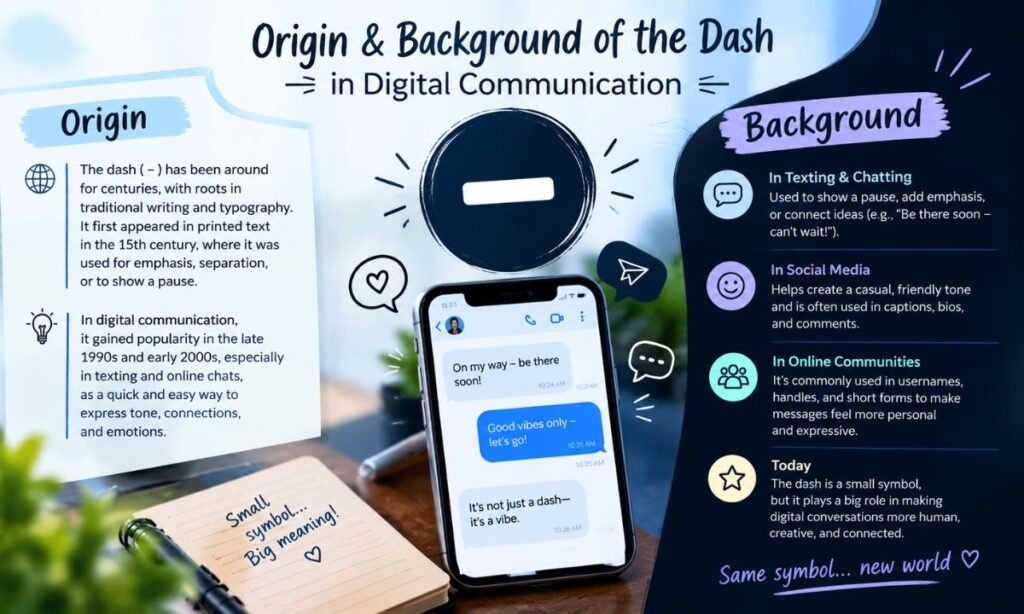
Origin & Background of the Dash in Digital Communication
From Grammar to Online Tone
The dash did not begin as a texting trick. Writers have used it for centuries to mark breaks in a sentence, add extra detail, or show that speech was interrupted. Novelists and playwrights used it to show a character trailing off or being cut short.
The classic dash meaning in print was always about rhythm. It tells the reader to slow down, pause, or brace for something. Early digital chat kept this habit. When typing replaced talking, people needed a quick way to show hesitation, and the dash was already there.
Social Media Influence
Social media pushed the dash further. Short, fast messages leave little room for tone, so users started packing emotion into punctuation. Ellipses (…) became a sign of doubt. Periods began to feel cold. The dash settled into its own space: abrupt, a little dramatic, and often awkward.
Apps like WhatsApp and Instagram favor quick, broken-up messages, which suits the dash perfectly. On TikTok, commenters use it to show they are speechless or “dead” from laughing. Over time, the modern dash meaning picked up emotional shades that grammar books never planned for.
Real-Life Conversations Using “-“
Seeing the dash in action makes the dash meaning much clearer. Here are four common settings.
WhatsApp Conversation
Sara: “So I told my boss I’d finish the report by tonight.”
Ali: “Wait, the one that’s 40 pages-“
Sara: “Yes.”
Ali: “-“
Ali’s dash shows disbelief. He is picturing the workload and cannot finish the thought.
Instagram DM
Maya: “Remember that guy I told you about? He just followed me.”
Zoe: “Oh my- the one from the party?”
Maya: “Yep.”
Zoe’s dash after “my” shows excitement and a cut-off reaction. It feels playful, not negative.
TikTok Comments
“The way he walked in like- 😭”
“Bro really said- I’m done.”
On TikTok, the dash often replaces a punchline. The commenter is saying, “I can’t even explain how funny or shocking that was.”
Text Message
Jordan: “Did you get my message about dinner?”
Chris: “I did, I just-“
Jordan: “You just what?”
Chris’s trailing dash signals hesitation. He is probably avoiding something, and Jordan picks up on it right away.
Uses of Dash with Examples
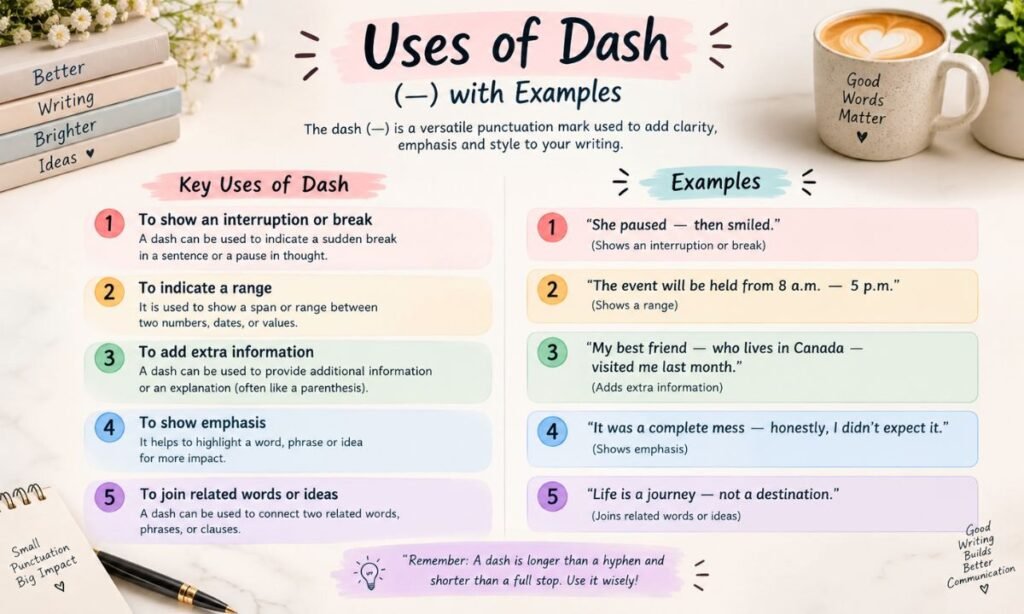
The dash does several jobs in chat. This table covers the most common ones, with an example for each.
| Use | What it does | Example |
| Trailing off | Leaves a thought unfinished | “I thought maybe we could-“ |
| Interruption | Shows a sentence being cut | “But you said you’d-“ |
| Hesitation | Shows nervous or unsure feelings | “I mean- yeah, sure” |
| Shock | Shows being stunned | “He actually-“ |
| Emphasis | Adds a pause before a reveal | “Guess who’s coming – my ex.” |
| Aside | Adds extra info | “My sister – the loud one – is here.” |
| Silent reaction | Replaces words entirely | “-“ |
Notice that one symbol covers six or seven moods. That flexibility is why the dash meaning feels so slippery. The same mark can be funny in one chat and tense in another.
Dash Meaning in Grammar
Before it became a texting habit, the dash was a punctuation mark. Knowing the grammar side helps you read the digital side with more confidence.
In writing, there are three marks that look alike:
- Hyphen (-): joins words, like “well-known.”
- En dash (–): shows ranges, like “2020–2024.”
- Em dash (—): marks a break or a strong pause.
The grammatical dash meaning is simple: a dash separates parts of a sentence to add emphasis, extra detail, or a sudden shift. In text messages, most people use the plain hyphen key because it is the easiest to find, and it takes on the dash role by habit.
Grammar example: “She had one rule – never be late.” The dash adds weight to the rule.
En Dash
The en dash (–) is slightly longer than a hyphen and shorter than an em dash. Its name comes from its width, which traditionally matched the letter “n.” You will mostly see it in formal or edited writing, not in casual chat.
En Dash Meaning
The en dash meaning is “up to” or “through.” It connects numbers, dates, and places that form a range or a link.
Examples:
- Pages 10–20
- Monday–Friday
- The London–Paris train
It can also show a relationship between two things, like a “win–loss record.” In texting, you will rarely see it used on purpose, but it often appears when phones auto-format a hyphen.
En Dash vs Em Dash
| Feature | En Dash (–) | Em Dash (—) |
| Length | About the width of “n” | About the width of “m” |
| Main job | Shows ranges and links | Marks breaks or emphasis |
| Example | 9am–5pm | “I knew it—she lied.” |
| Where used | Formal, edited writing | Stories, blogs, casual writing |
| Texting use | Rare | Occasional |
A quick memory trick: the en dash is for numbers, and the em dash is for drama.
Dash Symbol on Keyboard
Most keyboards have only a hyphen key, next to the zero. That is the “-” people use in chats. To type longer dashes, you need shortcuts.
Dash Symbol Example
Here is how the three look side by side:
- Hyphen: well-known (-)
- En dash: 2020–2024 (–)
- Em dash: Wait—what? (—)
En Dash Keyboard
Here are the common ways to type each one:
| Device | En Dash (–) | Em Dash (—) |
| Windows | Alt + 0150 | Alt + 0151 |
| Mac | Option + Hyphen | Option + Shift + Hyphen |
| iPhone | Long-press the hyphen key | Long-press the hyphen key |
| Android | Long-press the hyphen key | Long-press the hyphen key |
| Microsoft Word | Ctrl + Minus (numpad) | Ctrl + Alt + Minus (numpad) |
If you only want a quick dash for chatting, the plain hyphen works fine.
Emotional & Psychological Meaning of “-“
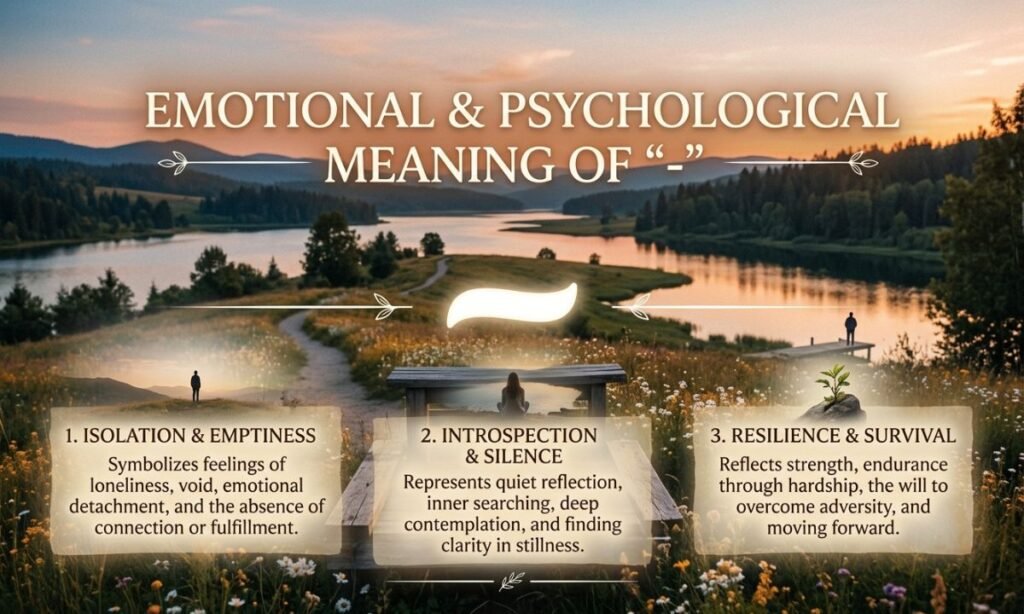
The dash is small, but it carries real emotional weight. People read it the way they read a pause in a voice. The emotional dash meaning usually falls into three groups.
It Can Show Hesitation
When someone is unsure, they often type a dash instead of finishing the sentence. It says, “I’m thinking, but I’m not ready to say it.”
Example: “I don’t know if I should-“
The reader senses doubt right away. It feels more human than a clean, complete sentence.
It Can Express Shock
A dash can capture the moment your brain freezes. Words fail, so the sentence breaks off.
Example: “You got the job? You actually-“
Here, the dash shows surprise, not anger. The sender is overwhelmed in a good way.
It Can Create Awkwardness
Sometimes the dash makes a conversation feel tense. A lone “-” after a serious question can sound cold or uncomfortable.
Example:
“Are you coming to my birthday?”
“-“
Psychologically, silence in text creates anxiety because we can’t see a face. The dash fills that gap with uncertainty, which is why it can feel heavier than it really is.
How “-” Is Used in Different Contexts
The right reading of the dash meaning depends on where you see it.
Social Media
On social platforms, the dash is mostly playful. It shows disbelief, humor, or “I’m speechless” energy. Comments like “Not him doing that-” are common and lighthearted.
Friends and Relationships
Between close friends, a dash often feels casual or teasing. In romantic chats, it can show nerves, shyness, or unspoken feelings.
Example: “I really like spending time with you, I just-“
The dash invites the other person to ask, “You just what?” It can also signal that something heavier is coming.
Work and Professional Settings
At work, dashes are best kept for proper grammar, not emotion. A message like “Please review the report – attached below” is fine. But a lone “-” to a manager can look rude or confusing.
Casual vs. Serious Tone
| Tone | How the dash appears | Example |
| Casual | Playful, quick, relaxed | “Bro- no way” |
| Serious | Heavy, hesitant, tense | “I need to tell you something-“ |
| Professional | Grammatical, clean | “The deadline – Friday – is firm.” |
Always read the mood of the chat before deciding what a dash means.
When NOT to Use “-“
A dash is useful, but it is not always wise. Avoid it in these cases.
Sensitive Conversations
If someone shares bad news, a lone dash can feel dismissive. They may think you don’t care. Use real words instead.
Better: “I’m so sorry. I’m here if you need me.”
Cross-Cultural Communication
People from different backgrounds read punctuation differently. A dash that feels playful to you may feel cold to someone else. When chatting across cultures, or with someone unfamiliar with texting slang, write full sentences.
Also avoid the dash in formal emails, job applications, and anything where clear meaning matters more than style.
Common Misunderstandings About “-” in Text
Many people misread the dash. Here are the biggest myths.
“-” Does Not Automatically Mean Annoyance
A lot of people assume a dash equals anger. It doesn’t. In many chats, it means surprise, laughter, or confusion. Judge it by the surrounding conversation, not the symbol alone.
A Dash Is Not Always Slang
Sometimes a dash is just punctuation. If someone writes “Our meeting – 3 PM – is moved,” they are using standard grammar. Not every dash is a hidden emotional signal.
“Okay-” and “Okay.” Are Different
| Message | Likely tone |
| “Okay-“ | Hesitant, unsure, maybe has more to say |
| “Okay.” | Final, flat, or slightly cold |
| “Okay!” | Friendly, enthusiastic |
| “Okay…” | Doubtful or reluctant |
The dash leaves the door open. The period closes it.
“-” Compared With Similar Texting Expressions
The dash often gets mixed up with other punctuation habits. This table shows how they differ.
| Expression | Typical meaning | Compared to “-“ |
| “…” | Doubt, thinking, or sadness | Softer and slower than a dash |
| “.” | Finality, sometimes coldness | More closed than a dash |
| “?” | Question or confusion | Direct, while a dash is vague |
| “—” (em dash) | Strong pause or break | Longer, more dramatic |
| “-_-“ | Annoyed or unimpressed face | Clearer emotion than a plain dash |
Key Insight
A dash is unfinished. An ellipsis is hesitant. The period is final. Once you see that pattern, the dash meaning becomes much easier to read in any chat.
10 Variations of “-” in Texting
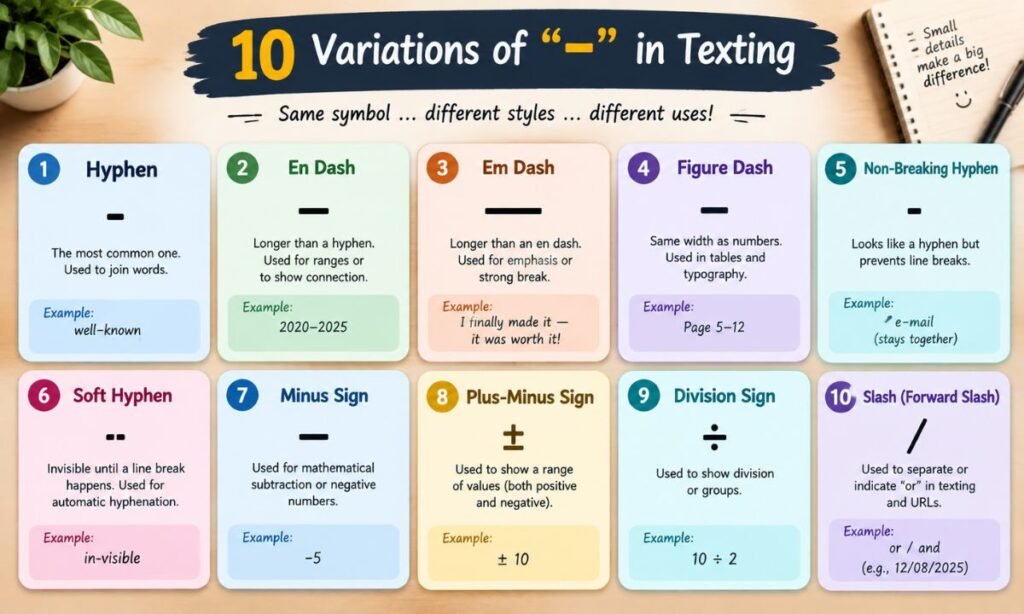
Here are ten common forms, with what each usually means.
1. “-“
A lone dash. It means speechless, awkward, or “no comment.”
2. “Wait-“
Used to stop a conversation or catch a sudden realization.
“Wait- did you just say you’re moving?”
3. “Oh-“
A soft reaction to new information, often mixed with surprise or mild disappointment.
“Oh- I didn’t know that.”
4. “Okay-“
A hesitant agreement. The person may have doubts.
“Okay- if you think that’s best.”
5. “But-“
Shows the start of an objection that gets cut off.
“But- I thought we agreed.”
6. “I mean-“
A common lead-in for clarifying or softening a thought.
“I mean- it’s not terrible.”
7. “What-“
Pure confusion or disbelief.
“What- how did that happen?”
8. “Bro-“
A casual, dramatic reaction, popular among younger users.
“Bro- that’s insane.”
9. “You actually-“
Used when someone can’t believe what another person did.
“You actually forgot my birthday-“
10. “-_-“
Strictly a face, not a plain dash. It shows annoyance, boredom, or being unimpressed.
“You’re late again -_-“
How to Respond When Someone Uses “-“
Your reply should match the mood you sense. Here are some ideas.
Casual Replies
- “Everything okay?”
- “You were saying?”
- “Don’t leave me hanging!”
Funny Replies
- “That dash says a lot 😂”
- “Did my message break you?”
- “Use your words, my friend!”
Mature Replies
- “It seems like something is on your mind. Want to talk about it?”
- “I’m happy to listen if you want to finish that thought.”
Respectful Replies
- “No pressure. Take your time.”
- “If you’d rather not say, that’s okay too.”
If the mood feels tense, ask a gentle question instead of guessing. A simple “What did you want to say?” often clears things up fast.
Regional & Cultural Usage of “-“
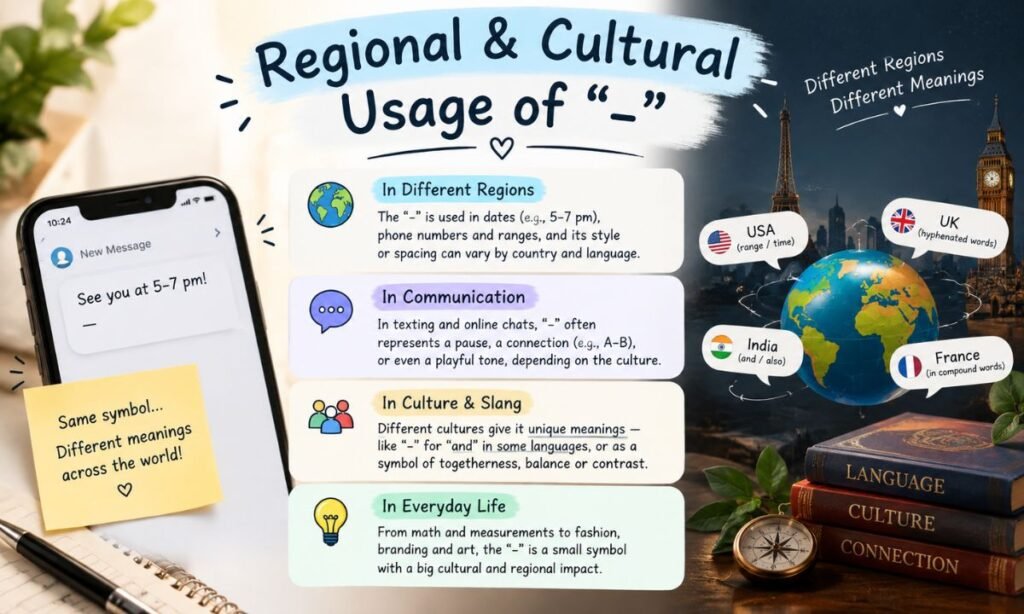
Texting habits shift across regions, so the dash meaning can feel a little different depending on where you are.
Western Internet Culture
In the US, UK, and Canada, the dash often shows interruption, sarcasm, or dramatic pauses. It is common in memes, comment sections, and group chats.
Asian Digital Culture
In many Asian online spaces, people lean on emoticons, stickers, and tildes more than dashes. A dash may appear, but emotional tone is usually carried by cute symbols or emojis.
Middle Eastern Digital Culture
Chats are often warm and expressive, so people may use full phrases and voice notes over punctuation. Dashes appear mostly as grammar, with a lone “-” being less common.
Global Internet Usage
Because of shared apps and viral trends, the dash is spreading everywhere. Still, local habits matter. When in doubt, ask instead of assuming.
Gen Z vs. Millennials
| Group | Typical use of the dash |
| Gen Z | Dramatic, playful, reaction-focused (“Bro-“) |
| Millennials | More grammatical, sometimes for pauses or asides |
| Older users | Mostly standard punctuation |
Gen Z treats the dash as an emotional tool. Millennials tend to keep it closer to its grammar roots.
Is “-” Safe for Kids?
Yes. The dash is just a punctuation mark, and it carries no harmful or inappropriate meaning. Kids use it to show surprise, hesitation, or humor, just like adults.
Parents should focus on the content of the chat, not the dash itself. If a child sends a lone “-” in a serious moment, it may be worth checking in kindly. It could simply mean they are unsure how to explain something.
FAQs About “-” Meaning in Text Message
What does “-” mean in a text message?
It usually means a pause, a cut-off thought, or being speechless. The exact tone depends on the conversation.
What is the dash meaning when someone sends it alone?
A lone dash often shows shock, awkwardness, or “I have no words.” It can also be a typo.
Does a dash mean someone is angry?
Not necessarily. It often signals surprise, confusion, or humor rather than anger.
What is the difference between an en dash and an em dash?
An en dash (–) shows ranges like 2020–2024. An em dash (—) marks a strong break in a sentence.
What is the en dash meaning in simple words?
It means “to” or “through,” linking numbers, dates, or places, such as Monday–Friday.
How do I type a dash on my phone?
Long-press the hyphen key on iPhone or Android to see longer dash options.
How do I type an en dash on a keyboard?
On Windows, press Alt + 0150. On a Mac, press Option + Hyphen.
Is “Okay-” different from “Okay.”?
Yes. “Okay-” sounds hesitant or unfinished, while “Okay.” sounds final and sometimes cold.
Is it rude to send a dash at work?
A lone dash can seem unclear or dismissive. Use full sentences in professional chats.
Is the dash popular with Gen Z?
Yes. Gen Z uses it often for dramatic or humorous reactions.
Is “-” safe for kids to use?
Yes. It is a harmless punctuation mark with no inappropriate meaning.
Conclusion
A tiny line can hold a surprising amount of feeling. The dash meaning in text is not fixed: it can show hesitation, shock, awkwardness, humor, or a thought left hanging. The best way to read it is to look at the full conversation, the sender’s usual style, and the platform you are on.
Remember the basics. In grammar, dashes add emphasis, show ranges, or mark breaks. In texting, they show emotion through silence. If you ever feel unsure, don’t guess. Ask a simple, kind question.
