

Slang evolves fast, and Snapchat is one of the biggest breeding grounds for new abbreviations. Because messages on the app are short-lived and conversations move at lightning speed, users naturally gravitate toward compact expressions that still carry emotional weight.
If you have ever opened a Snapchat message and seen someone reply with just “DW,” you are not alone in wondering what it means. Understanding the DW meaning has become essential for anyone who chats regularly on Snapchat, Instagram, WhatsApp, or TikTok, because this tiny abbreviation shows up everywhere in casual digital conversation.
Whether you’re a parent trying to keep up with your teenager’s messages, a new Snapchat user, or simply someone who wants to text more fluently, learning the DW meaning (and the many ways it shows up) will make your digital conversations much smoother.
What Does DW Mean on Snapchat?
Quick Definition
On Snapchat, the DW meaning is almost always “Don’t Worry.” It is a short, friendly way to reassure someone, calm them down, or brush off a small issue without making a big deal out of it.
People also use DW as shorthand for a few other phrases depending on context, such as:
- Don’t Worry (the most common DW meaning by far)
- Dear Wife (used mostly in messages between married couples)
- Driving While (used in specific safety-related contexts)
- Documentary World or Data Warehouse (technical or niche uses, rarely seen in chat)
On Snapchat specifically, the “Don’t Worry” DW meaning dominates almost every conversation. If a friend sends “dw” after you apologize for something, they are telling you it’s genuinely fine.
Simple Examples
- “Sorry I missed your snap!” → “DW, I was busy too.”
- “I think I said something awkward in the group chat.” → “DW about it, nobody noticed.”
- “I can’t make it tonight.” → “DW, we’ll hang out another time.”
Why People Use DW
Snapchat conversations move fast, and disappearing messages encourage short, casual replies. The DW meaning fits perfectly into this style because it delivers comfort and reassurance in just two letters.
There’s also a social element behind the popularity of the DW meaning. Typing out a full response like “please don’t worry about it, everything is totally fine” can feel overly formal or even a little awkward in a fast, casual chat.
DW strips away that formality and replaces it with something quick, friendly, and effortless. It signals familiarity, the kind of shorthand you only use with people you’re comfortable with.
That’s part of why the DW meaning feels so natural between close friends, siblings, and partners, but slightly out of place in more distant or formal relationships. Instead of typing out a full sentence, users can express empathy instantly, which keeps the conversation flowing naturally.
Origin & Background
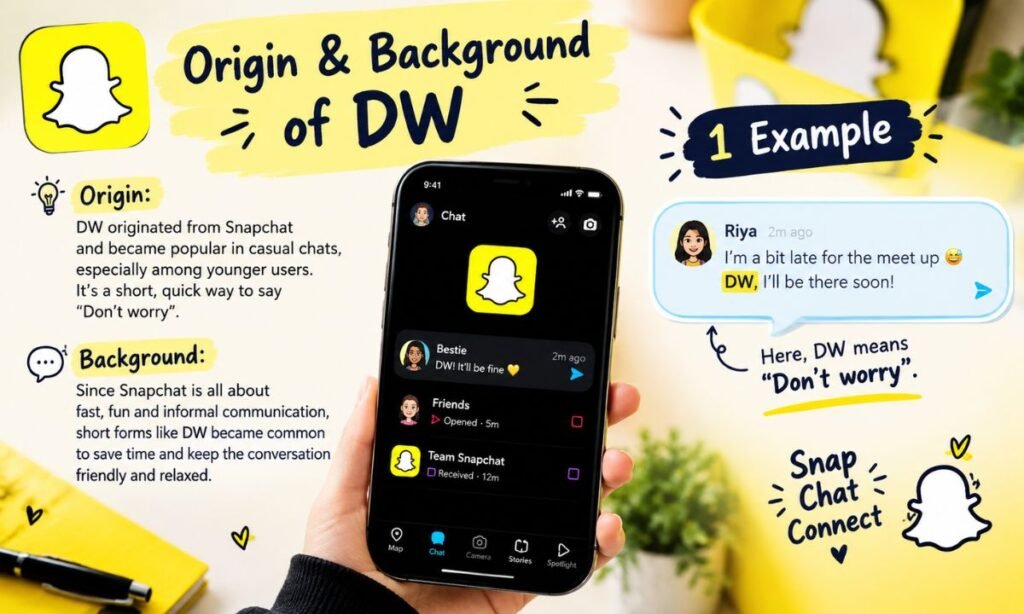
Where Did DW Come From?
The DW meaning traces back to early text messaging culture, when character limits and slow typing on small keypads pushed people to shorten common phrases. “Don’t Worry” became “DW” for the same reason “Be Right Back” became “BRB” and “Laughing Out Loud” became “LOL.”
The Influence of Internet Culture
As internet forums, instant messengers, and early chat rooms grew in the 2000s, abbreviations like DW spread quickly because they were easy to type and instantly understood by other frequent users.
Social Media’s Role
When platforms like Snapchat, Instagram, and Twitter took off, they inherited this abbreviation culture. Snapchat in particular, with its emphasis on quick, informal, disappearing messages, became one of the biggest homes for the DW meaning in everyday use.
How the Meaning Evolved
Originally a purely practical shortcut, the DW meaning has picked up emotional nuance over time. Today it can signal:
- Genuine reassurance
- Casual dismissal of a minor issue
- Warmth and closeness between friends
- Sometimes, gentle sarcasm (though this is less common)
Interestingly, the DW meaning has also become something of a social signal. Using it correctly at the right moment, in the right tone shows that you’re fluent in modern digital communication. Misusing it, on the other hand (for example, replying “dw” to genuinely bad news), can come across as careless.
This evolution shows how a simple abbreviation can gain real social weight over time, moving from a basic space-saving trick to a nuanced part of how people express empathy online.
What Does DW Mean in Text from a Guy?
When a guy uses DW in a text, the DW meaning is generally still “Don’t Worry,” but the tone can carry different weight depending on the relationship. From a friend, it usually signals casual reassurance.
From a romantic interest, “DW, I’ve got it handled” can carry a protective or caring undertone, showing he wants to ease your mind.
DW Meaning from a Girl
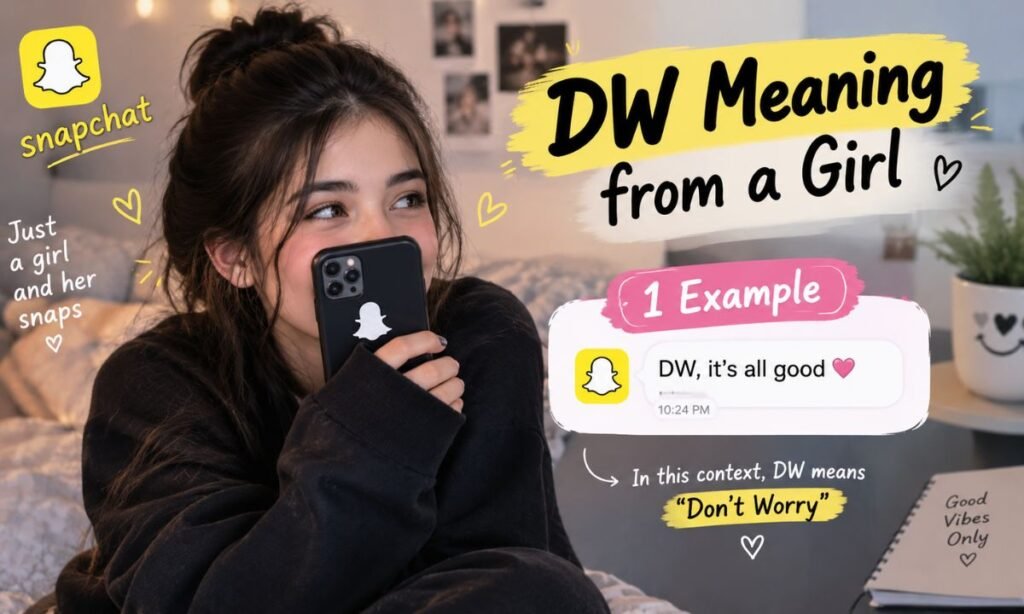
The DW meaning from a girl works the same way at its core “Don’t Worry” but it often leans more emotionally supportive. Girls frequently pair DW with extra warmth, such as “dw, you’re fine 💕,” which softens the reassurance and adds a personal touch.
DW Meaning in WhatsApp
On WhatsApp, the DW meaning stays consistent with other platforms, standing for “Don’t Worry.” Because WhatsApp is often used for more personal, one-on-one conversations, the DW meaning here tends to feel slightly more intimate and direct compared to a public comment on TikTok or Instagram.
What Does DW Mean Texting
In general texting through SMS or iMessage, the DW meaning is used to keep replies short while still being reassuring. It works well in situations like:
- Confirming plans without overexplaining
- Comforting someone after a mistake
- Signaling that everything is under control
Real-Life Conversations
Seeing the DW meaning in action makes it much easier to understand. Here are examples across different apps.
WhatsApp Conversation
Friend: “I totally forgot to send you the notes, so sorry!” You: “DW, I got them from someone else already.”
Instagram DM Conversation
Friend: “Ugh, I liked your old photo by accident while stalking your profile lol.” You: “DW, happens to everyone 😂”
TikTok Comment Section
Commenter: “I think I look weird in this video.” Reply: “dw you look great, stop overthinking it”
Text Message Conversation
Text 1: “Running 10 mins late!” Text 2: “dw take your time”
In every example, the DW meaning delivers the same core message: relax, it’s not a problem.
It’s worth noting how the tone of the DW meaning can shift slightly depending on punctuation and capitalization. “DW.” with a period can feel more direct and final, almost businesslike. “dw” in lowercase, especially followed by an emoji or “lol,” feels softer and more playful.
“DW!!” with extra emphasis often shows enthusiasm or a stronger attempt at reassurance. Paying attention to these small details helps you read the real emotional temperature behind the DW meaning in any given message.
Emotional & Psychological Meaning
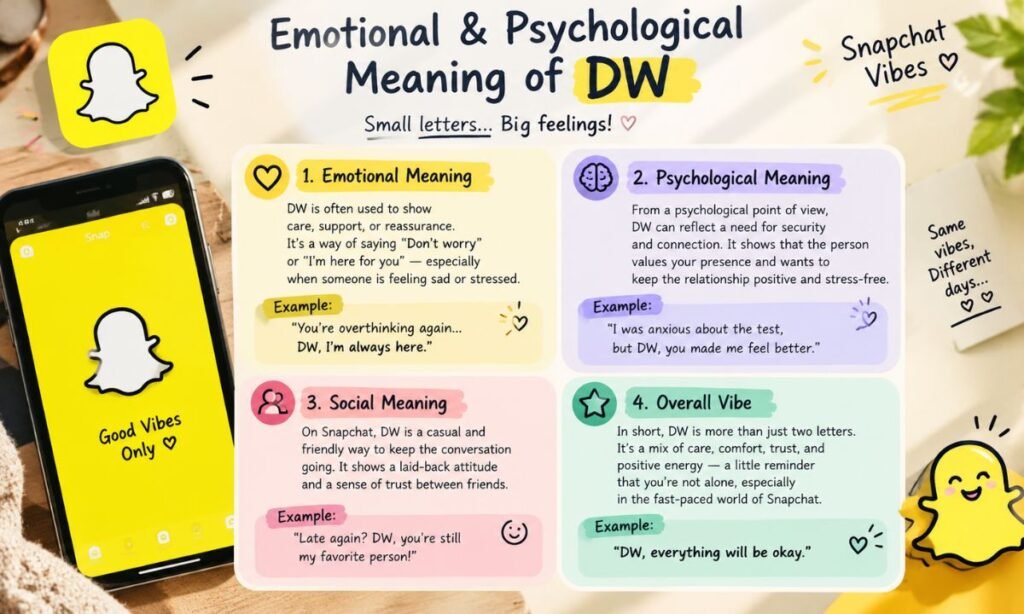
What Emotion Does DW Express?
At its heart, the DW meaning expresses reassurance, empathy, and calm. It is a small verbal gesture that tells the other person their feelings are acknowledged but that there’s no need to spiral over the situation.
Why People Use It
People reach for DW because it is fast, low-pressure, and emotionally warm without requiring a long explanation. In a culture of quick replies, the DW meaning lets someone offer comfort without slowing down the conversation.
What It Reveals About Modern Communication
The popularity of the DW meaning reflects how modern digital communication favors brevity paired with emotional intelligence. We want to be kind and supportive, but we also want to keep messages short DW checks both boxes.
Personal-Style Scenario
Imagine you accidentally like an old photo on someone’s profile while scrolling late at night. You send an awkward apology, and they simply reply “dw lol.” In two letters, they’ve told you it’s not weird, they’re not upset, and the moment is already forgotten.
Research on digital communication suggests that short, immediate responses can reduce anxiety faster than delayed, longer explanations, simply because they arrive quickly and require little mental effort to interpret.
This is likely another reason the DW meaning has stuck around: it delivers comfort at the exact speed modern conversations demand, without making the sender or receiver overthink the exchange.
Usage in Different Contexts
Social Media
Across Snapchat, Instagram, and TikTok, the DW meaning is used constantly in comments, captions, and direct messages to reassure followers or friends about minor mishaps, embarrassing posts, or delayed replies.
Friends & Relationships
Between friends, the DW meaning often signals trust and closeness. Between partners, it can carry extra warmth, sometimes doubling as a small term of comfort during stressful moments.
Work or Professional Settings
While informal, the DW meaning does occasionally appear in casual workplace chats (like Slack or Teams) between coworkers who know each other well. It is not appropriate for formal emails or client-facing communication.
Some newer, more relaxed workplaces have embraced casual chat culture, especially among remote teams communicating through instant messaging apps.
In these environments, a quick “dw, I’ll handle it” between colleagues can build camaraderie without sacrificing professionalism, as long as it’s reserved for internal, informal exchanges.
The moment a client, manager outside your usual team, or formal report is involved, it’s safer to fall back on the full phrase rather than lean on the shorthand DW meaning.
Casual vs Serious Tone
| Context | Tone | Example |
| Friends chatting | Light, playful | “dw it’s not a big deal” |
| Comforting someone upset | Warm, sincere | “DW, I’m here for you” |
| Gaming with teammates | Confident, quick | “dw I got this round” |
| Professional chat (casual team) | Reassuring, brief | “DW, I’ll send the file by 5” |
Across all of these contexts, the underlying DW meaning stays remarkably stable, it’s the surrounding words, punctuation, and relationship between the two people chatting that shift the tone.
A single “dw” from a stranger online might feel neutral or even dismissive, while the same “dw” from your best friend can feel like a warm hug. This flexibility is exactly why the DW meaning has managed to stay relevant across so many different corners of the internet, from gaming lobbies to heartfelt DMs.
When NOT to Use It
Professional Communication
In formal emails, client messages, or official documents, the DW meaning is too casual and can come across as unprofessional. Stick to full phrases like “Please don’t worry about this” instead.
Sensitive Situations
If someone shares something serious grief, a health scare, or a major life problem using DW can feel dismissive rather than comforting. In these moments, a fuller, more thoughtful response is far more appropriate than a quick abbreviation.
Cultural Differences
Not everyone is familiar with internet slang. Older relatives, non-native English speakers, or people less active on social media may not immediately understand the DW meaning, so context matters.
It’s also worth considering the setting before you send it. A quick “dw” works great in a Snapchat reply to a friend, but the same message in a customer service chat, a college application follow-up, or a message to a teacher can come across as too relaxed.
When in doubt, it’s safer to spell out “don’t worry” in full rather than relying on the shorthand DW meaning, especially with people you don’t know well.
Common Misunderstandings
Thinking DW Means Something Negative
Some people new to texting slang assume DW might be short for something rude or negative. In reality, the DW meaning is almost always positive and reassuring.
Assuming It Is Sarcastic
Occasionally, tone can make DW feel sarcastic (for example, “dw, I’m totally fine” after clearly being upset). Context and prior messages usually make the real intent clear.
Literal vs Emotional Meaning
Literally, DW just stands for “Don’t Worry.” Emotionally, it can carry everything from genuine comfort to light humor, so reading the surrounding conversation is key to understanding the full DW meaning.
A good rule of thumb: if the message before “dw” describes something small (a typo, a late reply, a minor slip-up), the DW meaning is almost certainly sincere reassurance.
If it follows something that sounds like a complaint about the other person, it might carry a hint of sarcasm. Context, tone, and your history with the sender are always the best guide.
Comparison Table
| Term | Meaning | Common Platform |
| DW | Don’t Worry | Snapchat, WhatsApp, Instagram |
| NVM | Never Mind | Texting, Twitter |
| IKR | I Know, Right | Instagram, Snapchat |
| NP | No Problem | WhatsApp, Texting |
| ILY | I Love You | All platforms |
Key Insight
Compared to similar reassurance terms like NP (“No Problem”) or NVM (“Never Mind”), the DW meaning carries a slightly warmer, more personal tone, which is why it remains a favorite among close friends and couples.
Variations / Types
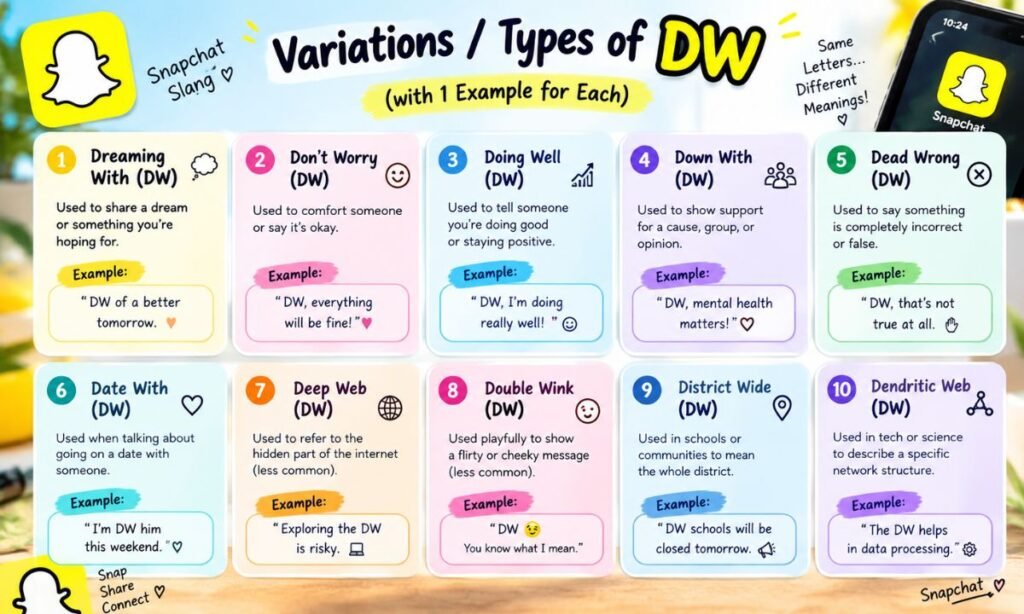
The core DW meaning stays the same across these common variations, though tone and emphasis shift slightly:
- DW – the standard, most common form
- DWW – an emphasized or playful version, sometimes used for extra reassurance
- DW Bro – casual, common between male friends
- DW Mate – common in British or Australian slang
- DW About It – a slightly more complete phrasing of the same reassurance
- DW I’ll Handle It – shows confidence alongside comfort
- DW We Got This – used to reassure a group or team
- DW Everything’s Fine – a fuller, softer version
- DW You’re Good – common after a small mistake or accident
All of these variations share the same underlying DW meaning: things are okay, so relax.
You’ll also notice the DW meaning stretches into slightly longer combinations depending on the platform. On Snapchat stories, people sometimes write “dw guys, all good” to reassure their whole friend group at once.
In gaming voice chats, “dw, trust me” is a common shorthand for confidence under pressure. Even though the phrasing changes, the DW meaning at the core don’t worry, it’s handled never really shifts.
How to Respond When Someone Uses It
Casual Replies
- “okay, thanks lol”
- “appreciate you 😊”
- “good to know”
Funny Replies
- “dw yourself 😂”
- “noted, worrying cancelled”
- “phew, crisis averted”
Mature Replies
- “Thanks for the reassurance, I needed that.”
- “That helps, thank you.”
Respectful Replies
- “I appreciate you saying that.”
- “Thanks, that means a lot.”
Regional & Cultural Usage
Western Culture
In the US, UK, Canada, and Australia, the DW meaning is extremely common among teens and young adults, especially on Snapchat and Instagram.
Asian Culture
In many Asian countries, English-based texting slang including the DW meaning has been adopted by younger, internet-savvy users, often mixed with local language in bilingual chats.
Middle Eastern Culture
Across parts of the Middle East, the DW meaning is popular among younger social media users who frequently mix English abbreviations into Arabic or other local-language conversations.
Global Internet Usage
Because English-language internet slang spreads quickly through global platforms, the DW meaning is now recognized in casual chats worldwide, even among non-native English speakers.
Generational Differences
Younger users (Gen Z especially) use the DW meaning constantly and instinctively. Older generations may recognize it but use it less often, sometimes preferring the full phrase “don’t worry” instead.
Millennials tend to fall somewhere in the middle familiar with the DW meaning from years of texting and early social media use, but slightly more likely to spell things out in professional or family settings.
Gen Alpha, growing up entirely inside apps like Snapchat and TikTok, is likely to push the DW meaning (and slang in general) even further, blending it with new abbreviations and emojis as digital communication keeps evolving.
Is It Safe for Kids?
Understanding the Context
Yes,the DW meaning itself is completely harmless and simply reassuring. However, parents should stay aware of the broader context of a conversation, since slang terms are only one small part of understanding how kids communicate online.
Knowing common abbreviations like the DW meaning can actually help parents follow conversations more easily.Many parents worry when they see unfamiliar abbreviations pop up in their child’s messages, assuming the worst.
Frequently Asked Questions
What does DW mean on Snapchat?
The DW meaning on Snapchat is “Don’t Worry,” used to reassure someone or downplay a minor issue.
Is DW always positive?
Yes, in almost all cases the DW meaning is reassuring and positive, not negative or rude.
Does DW mean the same thing on every platform?
Mostly yes, the DW meaning stays consistent as “Don’t Worry” across Snapchat, Instagram, WhatsApp, and texting.
Can DW mean something other than “Don’t Worry”?
Occasionally, DW can mean “Dear Wife” in personal messages, but this is far less common than the standard DW meaning.
Is it okay to use DW in professional messages?
No, the DW meaning is too casual for formal or professional communication.
How do I reply when someone says DW?
A simple “thanks” or “okay, appreciate it” works well as a reply.
Why do people use DW instead of typing the full phrase?
The DW meaning offers a quick, effortless way to reassure someone without slowing down a fast-paced conversation.
Is the DW meaning the same in every English-speaking country?
Largely yes, though usage frequency varies it’s especially common among younger users in the US, UK, and Australia.
Can DW be used with strangers online?
It’s best used with people you already know, since the casual DW meaning can feel too familiar or unclear to someone you’ve just met.
Conclusion
The DW meaning is one of the simplest yet most widely used pieces of internet slang today. Whether you see it on Snapchat, WhatsApp, Instagram, or in a regular text message, it almost always boils down to one comforting idea: don’t worry, everything’s fine.
Now that you understand the full DW meaning its origins, emotional weight, variations, and appropriate contexts you’ll never be confused the next time it pops up in your chats. DW meaning proves that even the smallest abbreviations can carry real emotional value in our digital lives.
